Sunday, December 15, 2013

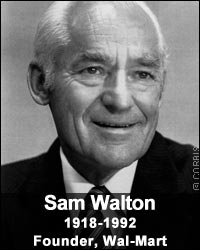
Sam Walton

Even when I was a child, my talent for entrepreneurship was obvious. Growing up on a farm in Oklahoma in the midst of the Great Depression, I helped support the family by delivering milk, taking on newspaper routes, and selling magazine subscriptions. After earning a business degree from the University of Missouri, I worked for J.C. Penney and joined the military. I owned a Ben Franklin franchise for a while, but then started the first Walmart store. This grew into the largest retailer in America, due to my innate talent for business, hard work, and useful discount marketing tactics. I was the wealthiest person in the country at one point, and have even been awarded the Presidential Medal of Freedom. How is it that I became the founder of both Walmart and Sam's Club? I have America to thank for that. It is a nation of opportunities for everyone, even those with rural upbringings. It gave me the chance to use my entrepreneurship skills and put them to the test. It allowed me to improve my financial situation and become a self-made businessman.

Zdenek Bakala

Communist Czechoslovakia

When I was living in communist Czechoslovakia, I felt as if I had no choice. I was forced to accept the fact that I would become a poor tradesman for the rest of my life. But then I had an idea. At the age of 19, I hid a 50 dollar bill in a sandwich and escaped to America in hopes of finding a better life there. I first took a job washing dishes at a casino. Later on, I got a degree from UC Berkeley and then Dartmouth. I returned to the Czech Republic in order to help push forward capitalism, investment banks, the stock market, and the coal industry. I spent long hours of work privatizing the society there, which had never been exposed to a free market before. I am now in charge of a successful coal company with sites throughout Central Europe, as well as several other companies. I definitely owe my success to America, truly a nation that benefits even poor immigrants like me. Living in a communist society, there were no opportunities open to me. However, with capitalism, opportunities were everywhere, and I made the most of them.

Herbert Spencer


I am most famous for popularizing the theory, Social Darwinism, which applies Charles Darwin's beliefs of evolution to society and economics. If for organisms, "survival of the fittest" is true, then it must also be true for aspects of human life. Those who are "best fit" with the most valuable genes will thrive and pass on their genes to future generations. Likewise, those who work hard will prosper in life and move up the social system to a higher class. If nature deems competition between organisms necessary, then who are we to deny Mother Nature? Competition between businesses and entrepreneurs is an important part of the economy, and is beneficial to the society as a whole. Besides, since it is human nature to be selfish, then a capitalist society works the best. Utopianism, communism, and other systems all rely on human nature to be selfless. But that's just not how it works. Individuals of that society are bound to be selfish, and desire private ownership and earning profits for themselves. Sorry, but no one is going to agree to having everything be shared and distributed equally. That would be denying our own nature. Capitalism meets the needs of humans, and it takes Mother Nature into account too. Capitalism does it all.

Leonardo Del Vecchio

In 2011, I was the 71st richest man in the world. Believe it or not, I grew up fatherless and in an orphanage, since my mother could not support her five children. At the age of 14, I became an apprentice for a tool manufacturer, where I had my first experience with eyewear. After I moved to the eyewear capital of Italy, I founded a glasses company that later grew into Luxottica, which globally dominates the manufacturing of eyewear and owns countless stores and brands, such as Lenscrafters, Sunglass Hut, Ray-Ban, and Oakley. I went from rags to riches, from a penniless child to a billionaire, and all because I lived in a capitalist society that allowed me to benefit from my hard work. Oh the places you'll go with capitalism!

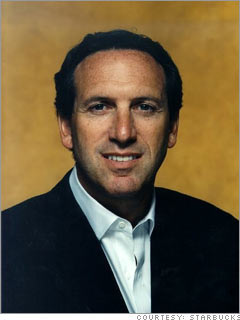
Howard Schultz

I was born into the lower middle class in 1953, and grew up in Brooklyn's housing projects. I was able to go to Northern Michigan University because of a football scholarship, and afterwards, I spent a few years working at Xerox Corporation. While later working for Hammerplast, a company that manufactured coffee makers, I visited Starbucks coffee company, a coffee bean shop, as part of my job. It was then that I realized what I wanted to do. I became their Director of Marketing, and set out to make Starbucks a place where people can not only drink coffee, but can also relax. I expanded the shop across the country. Today I am the CEO of Starbucks, and also own Seattle Supersonics. I have been given the International Distinguished Entrepreneur Award, in addition to the FIRST Award for Responsible Capitalism. My story, as well as countless others, goes to show that where you come from is not important. Although I was not born into a rich family, I was still able to become a thriving CEO, due to the fact that I live in a society full of opportunities.

Saturday, December 14, 2013

Harold Hamm


Today I live as a billionaire, but I certainly wasn't born one. I was born in 1945 in rural Oklahoma to sharecrop cotton farmers. I lived in a crowded one-bedroom house with 12 other siblings. Because I could not pay for college, I began working at a gas station. Nearby oil drilling stations first inspired me to chase after the dream of starting an oil company. Although I had no idea how to drill oil, I slowly accumulated information from any engineers or geologists I came across. By doing endless hours of work and studying maps, I was able to find a close by, unoccupied oil source, and drilled an oil well that changed my life. Due to its success and rising oil prices, I was able to start a drilling firm, eventually called Continental Resources. I learned geology at a university, expanded the firm across the US, and became a billionaire. Isn't it amazing how in a capitalist society like America, anyone can rise to prosperity? I was able to escape poverty, and transform from a gas station worker to the CEO of a successful company. Surely, anything is possible.

Wednesday, December 11, 2013

Ayn Rand

I was born in Russia in 1905 and became a famous writer, best known for putting forth the ideas of objectivism. This philosophy believes that humans live to serve themselves and to attain their own happiness. There is no "living for the good of the society." That's nonsense. It never works out in reality. Ever since I read about U.S. history when I was in high school, I have praised America as a true nation of freedom that other nations should look up to. It is a model of capitalism, where property rights are protected amongst other individual rights. As an objectivist, I completely disagree with any society that plans on redistributing wealth in a government-regulated economy. Giving equal amounts of wealth to everyone seems fair at first. But that would mean equal profits for the entrepreneur who created life-changing inventions and the same profits for a lazy person who did nothing. Is that fair? Absolutely not. These societies were based on the idea that everyone should be rich, leading happy lives. The wealthy shouldn't dominate over the poor. But if everyone is rich, isn't that the same thing as saying everyone's poor? And look: that's exactly what happened when communist nations all turned out to have miserable, starving people. The government controlled all means of production. Well that can't possibly become corrupt, now can it? Capitalism gives you the chance to move up to the wealthy class, while also limiting the government with a free market economy. A money-based society allows people to gain for themselves, which is what objectivism is all about.